
When oil prices go up or down, rig counts don’t always follow
Oil prices aren’t nearly as reliable an indicator of future activity as we’d like

Oil prices have been spiking for nearly 3 months now, since the onset of the Iran War.
But US rig counts aren’t budging.
And while the divergence is notable given the acute focus on the Strait of Hormuz, this breakdown between oil prices and rig counts is frustratingly common.
I did a big forecasting project in the summer of 2025 that produced multiyear outlooks.
I embraced Occam’s razor, using the simplest framework with the fewest assumptions to create a view of the future.
A super simple model is that today’s oil prices predict tomorrow’s rig count.
That didn’t work.
Okay, maybe the direction of travel of today’s oil prices predict the direction of travel of tomorrow’s rig count.
That also didn’t work.
It’s not that these assumptions are wrong. They’re just not always right. And they’re not right often enough that it quickly breaks down a forward-looking model.
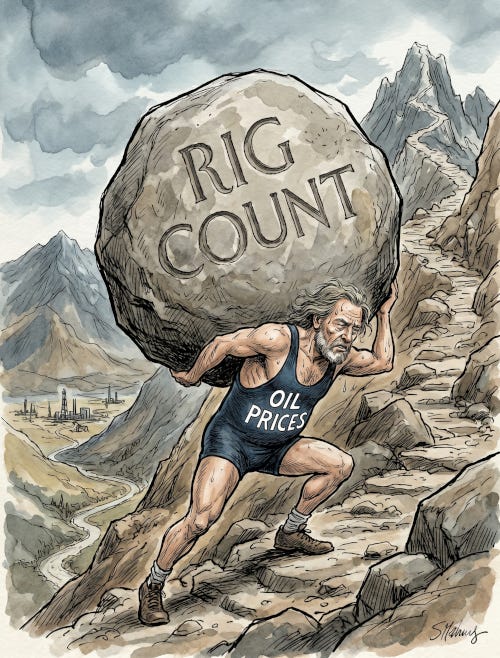
Here let’s take a look at the historical data to see the frustrating ways that oil prices fail to tell us about what happens in rig counts.
And this isn’t just commiseration. It’ll give us some food for thought as we approach 2027 planning season.
Let’s dive in.
There is no magic WTI level at which rig counts climb or fall
As we see in the chart below, rig counts can climb when WTI is “low”, and they can fall when WTI is “high”.
The chart shows us the history of total US rig count versus WTI going back to 2014. The green shaded area is rig count and maps to the left axis. The orange line is WTI price and maps to the right axis.
