
Three data-driven views of what US natural gas production could be in 2040
Teasing apart the impact of domestic consumption, the impact of LNG, and pipeline exports to Mexico and Canada

The market is bullish about the prospects for natural gas between now and 2040.
But is the optimism warranted? Or is it just the oil & gas industry trying to fight back against momentum around renewable energy?
In my recent presentations at conferences and corporate events, I have leaned into the divergence between the market realities around oil and gas, respectively, here in the US.
Oil is facing real questions around just how much more demand will materialize globally, and what the economics will look like as we approach this apex.
Gas is facing equal uncertainty, but almost all to the upside.
There are countless pathways where gas may play a larger role in our energy future. Even if it only grows at its rate from the past decade, gas producers and their service partners have a bright future ahead.
But “a bright future” is hand-waving.
So I built a data-driven, forward-looking model and used it to generate three views of US natural gas production out to 2040: a conservative case, a steady case, and an aggressive case.
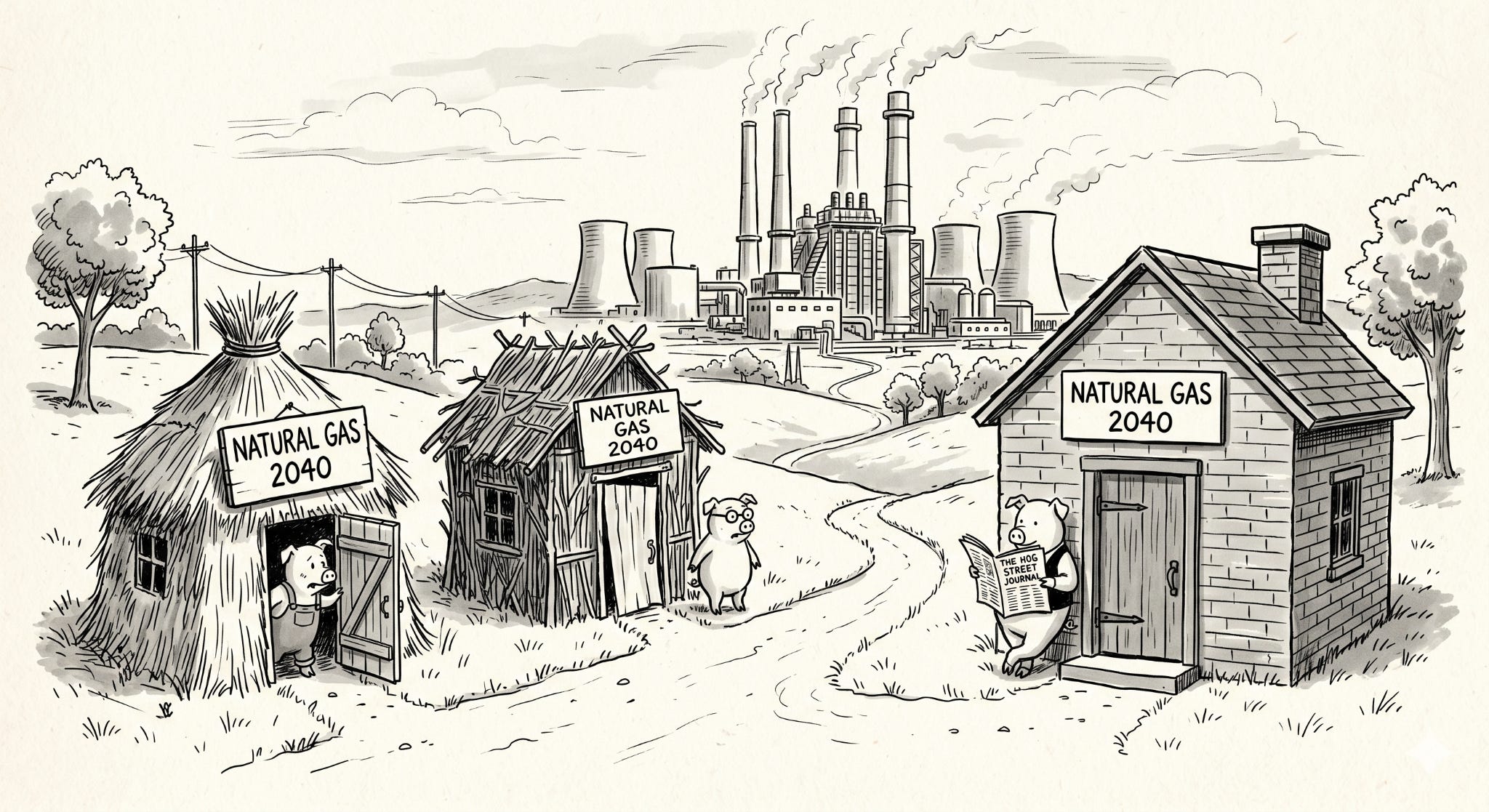
The spread between them is wide.
Even the most conservative scenario adds nearly 30 Bcfpd of new production over the next 15 years. The aggressive case more than doubles that.
The variability across these scenarios is in what’s driving the growth.
And that distinction has real consequences for how producers and their service partners should position.
Let’s dive in.
Before we jump into future scenarios, let’s revisit our wild ride to this point
The chart below shows US natural gas production going back to 1997.
Those are the blue bars that map to the left axis, in units of billion cubic feet per day (Bcfpd).
The orange circles are the year-over-year (YoY) change in production, and map to the right axis.
Just one glance at this chart reveals two entirely different stories in the history of US natural gas production.
